NCCCO Rigger Level I · Qualified rigger basics
Rigger Level I: Prep for Hooking and Unhooking in California
Most crane incidents start below the hook. A cut sling, a side-loaded shackle or a choker set at the wrong angle can drop a load no matter how good the operator is. Federal crane rules answer that with the idea of a qualified rigger, and California, as an OSHA State Plan, has to protect workers at least as well. NCCCO Rigger Level I is the entry credential many contractors in the state point to when they need to show their riggers know the basics. This course gets you ready for its written exam and for the inspection, hitch and knot skills the practical tests.
Reviewed · Our research standards
Topics in the prep
- What makes someone a qualified rigger under 1926.1425 and 1926.1404
- How the State Plan carries those duties onto Cal/OSHA sites
- Pre-use inspection of wire rope, chain, synthetic slings and hardware
- Removal-from-service criteria and tagging
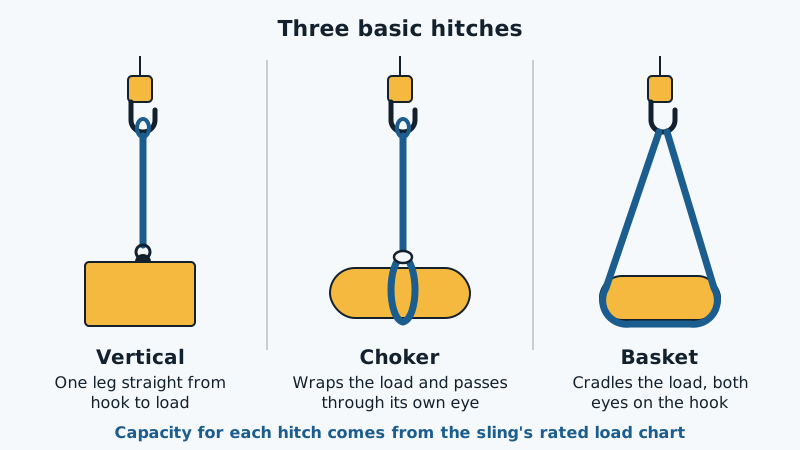
- Vertical, choker and basket hitches and how each affects capacity
- Shackles, hooks, eyebolts and connection orientation
- Basic knots used for taglines and light loads
- Fall zone awareness when hooking, unhooking and guiding loads
Where the qualified rigger rule comes from
Under federal Subpart CC, a qualified rigger is required whenever workers are in the fall zone hooking, unhooking or guiding a load, or making the initial connection of a load to a component or structure (1926.1425(c)). Crane assembly and disassembly also has to use qualified riggers (1926.1404). California's own crane orders, now in General Industry Safety Orders Group 13, cover assembly and disassembly in §5010.1, and as a State Plan Cal/OSHA's rules must be at least as effective as the federal ones.
OSHA's fact sheet is blunt about two points: holding a crane operator certificate does not automatically make someone a qualified rigger, and the employer decides who is qualified based on the load, the lift and the person's knowledge and experience. A third-party certificate does not replace that judgment, but it gives the employer solid evidence to base it on.
What NCCCO means by Level I
NCCCO defines a Level I rigger as someone who can carry out simple, repetitive rigging tasks once another person has already worked out the load weight, center of gravity and rigging configuration. The job description includes inspecting rigging before use, selecting and attaching it, using basic hitches and recognizing hazards. Calculating weights and planning non-routine lifts belongs to Rigger Level II.
There is no prerequisite certification. You need to meet NCCCO's general eligibility rules, including its age requirement and substance abuse policy.
California places Level I riggers are hooking loads
The work is everywhere, but some settings stand out. At the Port of Long Beach, the multi-phase Pier B On-Dock Rail Support Facility is expanding a rail yard from about 82 to 171 acres, with the first construction contract covering a new retaining wall along the 710 Freeway. In the Central Valley, high-speed rail crews set precast girders cast in Hanford, dozens per overpass. In Contra Costa County, refinery units at Rodeo and Martinez were reconfigured to produce renewable diesel, the kind of plant work where maintenance crews rig pumps, exchangers and piping inside tight unit layouts.
Each of those jobs depends on people who can look at a sling and know it is fit to use, then hang it correctly. That is the skill set Level I tests.
- Port and rail yard work: rail panels, precast walls, container-handling equipment parts
- Bridges and rail structures: girders, deck panels, rebar cages
- Process plants: valves, motors, exchanger bundles during shutdowns
- Commercial building: steel members, mechanical units, glazing
The two Rigger Level I exams
The CCO written exam is 60 multiple-choice questions with 60 minutes allowed, taken through Online Proctored Testing, at a test center or at an event. It focuses on inspection and on carrying out rigging tasks, with smaller portions on the scope of the role and technical knowledge.
The practical is hands-on and built from four tasks that step up in difficulty: pre-use inspection of rigging, rigging hitches, rigging connections and basic knots. You can take the exams in either order, but you have 12 months after passing the first to pass the other. Certification lasts five years.
Studying for Level I online
The course breaks the material into short units you can open on a phone during a break or on a laptop at home, at any hour. Inspection units walk through damage you will be asked to recognize, such as broken wires, kinks, heat damage, cuts in synthetic webbing and stretched or bent hardware. Hitch units explain why a choker reduces capacity and why sling angle matters before you ever touch a calculator. Practice questions after each unit help the material stick.
What it cannot do is put rigging in your hands. Practice the knots and hitches with real gear before your practical, ideally under a qualified rigger on your crew.
Questions people ask
Is a rigging certificate legally required in California?
Title 8 does not require a specific rigging certificate. It does require qualified riggers for certain tasks, and the employer decides qualification. A Level I credential is one common way to support that decision.
Do I need Level I before Level II?
Yes. Rigger Level II is only valid while your Level I certification is current.
Is longshore work aboard ships covered by Cal/OSHA?
Generally not. Longshoring aboard vessels falls under federal OSHA, while shoreside construction at the ports stays with Cal/OSHA. The requirements guide explains the split.
Where these facts come from (11)
- osha.gov/laws-regs/regulations/standardnumber/1926/1926.1425
- osha.gov/laws-regs/regulations/standardnumber/1926/1926.1404
- osha.gov/Publications/cranes-qualified-rigger-factsheet.pdf
- regulations.justia.com/states/california/title-8/division-1/chapter-4/subchapter-7/group-1
- osha.gov/stateplans/ca
- nccco.org/rigger
- nccco.org/nccco/certifications/rigger/practical-exam
- container-news.com/construction-works-commence-at-long-beach-pier-b-on-dock-rail-support-f
- railwayage.com/intermodal/polb-awards-first-pier-b-construction-contract
- railway.supply/california-high-speed-rail-opens-62nd-structure-as-central-valley-build-shi
- energy.ca.gov/data-reports/energy-almanac/californias-petroleum-market/californias-oil-ref
Prep courses
-
Mobile Crane
Online study for the NCCCO mobile crane Core written exam and the LAT, TLL or TSS specialty that matches your machine, framed around how Cal/OSHA actually checks operators on California jobs.
-
Tower Crane
Written exam preparation for the NCCCO tower crane certification, set against the extra layer of permits, notifications and certifier visits that Cal/OSHA applies to every tower crane in the state.
-
Articulating Crane
Study for the NCCCO articulating boom crane written exams online, with the California size limits that decide whether a material delivery truck needs a certified operator at all.
Line up your California crane exam prep
Share the card you need, the crane you run and the part of California you work in. An enrollment advisor writes back with a course match and a plan for booking your written and hands-on exams.
- Lessons and practice questions open around the clock
- Built for the NCCCO written tests Title 8 relies on
- Advice on scheduling the practical exam near you
Ask about enrollment
A short form. Your details are used only to reply to you.