Title 8 §5001.3 · NCCCO Signalperson
Signal Person Prep Built Around California's §5001.3
Cal/OSHA does not hand out a signal person card. What it does, in Title 8 §5001.3, is put the burden on the employer: before a worker signals a single pick, the company must be able to show that person is qualified. The rule gives two routes to that proof, and the one built on an outside, third-party evaluator is the one that follows a worker from contractor to contractor. This course prepares you for the NCCCO Signalperson exams, which many California contractors use for exactly that purpose, and it teaches the signals and crane behavior you need on the deck regardless of which route your employer picks.
Reviewed · Our research standards
Topics in the prep
- Title 8 §5001.3 Option 1 and Option 2, and what each one documents
- The four qualification criteria a California evaluator checks
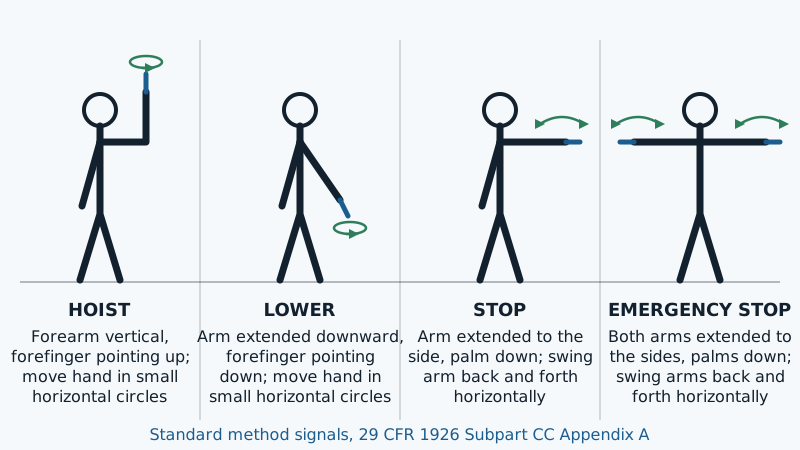
- Standard Method hand signals for mobile and tower cranes
- Voice and radio procedures, including pre-lift agreement on commands
- Swing, stopping distance, load drift and boom deflection
- Why anyone on site may call a stop, but only qualified people may direct a lift
- Blind picks over parapets, around tower cores and across traffic lanes
- How the written and practical CCO exams are scheduled and scored
Two routes to a qualified signaler under Title 8
Section 5001.3 lays out Option 1 and Option 2. Under Option 1, the signal person carries documentation from a third-party qualified evaluator showing the qualification criteria are met. Under Option 2, the employer's own qualified evaluator assesses the worker and writes up the finding. The catch with Option 2 is portability: another employer is not allowed to lean on that assessment, so a worker who changes companies starts over.
Whichever path is used, the employer keeps the paperwork available for as long as the signal person works there, and it has to name each signaling method the person is qualified for, such as hand signals or radio. A certificate from an accredited body like NCCCO is a common way contractors satisfy Option 1, because the same document works on the next job across the state.
The four things an evaluator is looking for
California's qualification criteria line up closely with the federal ones. An evaluator wants evidence that the worker:
- Knows and understands the type of signals used on that job, hand, voice or both
- Is competent at actually applying those signals in a live lift
- Has a basic grasp of how the equipment operates and where its limits are, including swinging and stopping a load and boom deflection under load
- Knows the signaling requirements in §§5001 through 5001.3
California lifts where the operator is working blind
A lot of the state's crane work happens out of the operator's line of sight. Precast girders for the Central Valley high-speed rail structures are cast in Hanford and set onto bents over canals, roads and State Route 99, often with the operator relying on someone at the landing point. The Golden Gate Bridge's final seismic retrofit phase is being done with the bridge kept open and lanes closed at night, the kind of setting where radio signaling and darkness change the job. Downtown San Francisco, Oakland and Los Angeles picks routinely land on roofs the operator cannot see from the cab.
Weather adds its own problems. Coastal fog can erase hand signals at a distance, afternoon onshore wind in the Bay and Santa Ana gusts in Southern California push suspended loads around, and inland valley heat slows reactions. The course treats each of these as a reason to switch methods, reposition, or stop the lift rather than push through.
Inside the NCCCO Signalperson exams
The CCO written exam is 60 multiple-choice questions with 60 minutes allowed. Its content areas are hand signals, voice communication, basic crane operations, situational awareness, and safety standards and regulations. You can sit it through Online Proctored Testing, at a test center, or at a scheduled test event.
The practical is hands-on: you give hand signals and voice commands and are judged on whether each one matches the Standard Method. NCCCO has described it as a demonstration that does not need a live crane or operator, and performances are scored off site. Pass the two exams in either order, within 12 months of each other. The credential runs five years, and unlike most CCO programs, renewal requires the practical again, with no grace period once it lapses.
What the online course does and does not do
You work through the material on your own schedule, from a phone, tablet or laptop, any hour of the day. Signal groups are introduced one at a time with practice questions that mirror the style of the written exam, then mixed so you learn to recall them out of order. Crane dynamics get their own unit, since understanding why a load keeps moving after the swing stops is what keeps a signaler from rushing a stop.
The course is preparation, not the qualification itself. The practical demonstration happens in person through NCCCO, and your employer still decides under §5001.3 whether you are qualified for the signals used on its site. Companies enrolling a whole crew can ask an enrollment advisor about group setup through the get started form.
Questions people ask
Does Cal/OSHA issue a signal person license?
No. The state requires the employer to confirm qualification under §5001.3, using a third-party evaluator or its own evaluator. The California requirements guide explains how this sits next to the operator certificate rules.
Can an unqualified worker ever signal the crane?
Only to stop it. Title 8 §5001 limits signaling to qualified persons, with one exception: anyone on site may give a stop signal, and the operator must obey it.
If my last employer qualified me in-house, does that count at my new job?
Not under Option 2. An employer's own assessment is not portable, so the new employer must assess you again or rely on third-party documentation such as an NCCCO certificate.
Should riggers take this course too?
Often, yes. Crews frequently pair it with Rigger Level I because the person hooking the load is so often the one guiding it to the landing.
Where these facts come from (10)
- dir.ca.gov/title8/5001_3.html
- law.cornell.edu/regulations/california/8-CCR-5001
- osha.gov/laws-regs/regulations/standardnumber/1926/1926.1428
- nccco.org/signalperson
- nccco.org/nccco/certifications/signalperson/practical-exam
- nccco.org/nccco/certifications/signalperson/recertification
- railway.supply/california-high-speed-rail-opens-62nd-structure-as-central-valley-build-shi
- hsr.ca.gov/wp-content/uploads/2025/10/2025_10_02_Factsheet_Construction_Progress_v2_A11Y.p
- equipmentworld.com/roadbuilding/article/15772538/golden-gate-bridge-seismic-retrofit-to-re
- goldengate.org/district/district-projects/seismic-retrofit/phase-3
Prep courses
-
Mobile Crane
Online study for the NCCCO mobile crane Core written exam and the LAT, TLL or TSS specialty that matches your machine, framed around how Cal/OSHA actually checks operators on California jobs.
-
Tower Crane
Written exam preparation for the NCCCO tower crane certification, set against the extra layer of permits, notifications and certifier visits that Cal/OSHA applies to every tower crane in the state.
-
Articulating Crane
Study for the NCCCO articulating boom crane written exams online, with the California size limits that decide whether a material delivery truck needs a certified operator at all.
Line up your California crane exam prep
Share the card you need, the crane you run and the part of California you work in. An enrollment advisor writes back with a course match and a plan for booking your written and hands-on exams.
- Lessons and practice questions open around the clock
- Built for the NCCCO written tests Title 8 relies on
- Advice on scheduling the practical exam near you
Ask about enrollment
A short form. Your details are used only to reply to you.