Title 8 certificate · NCCCO Core + specialty prep
Prepare for California's Mobile Crane Certificate, One Crane Type at a Time
California made operator certification a legal condition of running a mobile crane back in 2005, years before the federal deadline, so a crane company here will ask for your card before it asks how many hours you have. The state does not print its own license. Instead Title 8 expects a certificate from an accredited certifying body, and that certificate has to name the kind of crane you are sitting in. This course gets you ready for the NCCCO mobile crane written exams, the most common route to that certificate, at your own pace on a phone, tablet or laptop. The hands-on practical remains a separate, in-person test.
Reviewed · Our research standards
Topics in the prep
- Title 8 §5006.1 and §5006.2: who needs a certificate and for which crane type
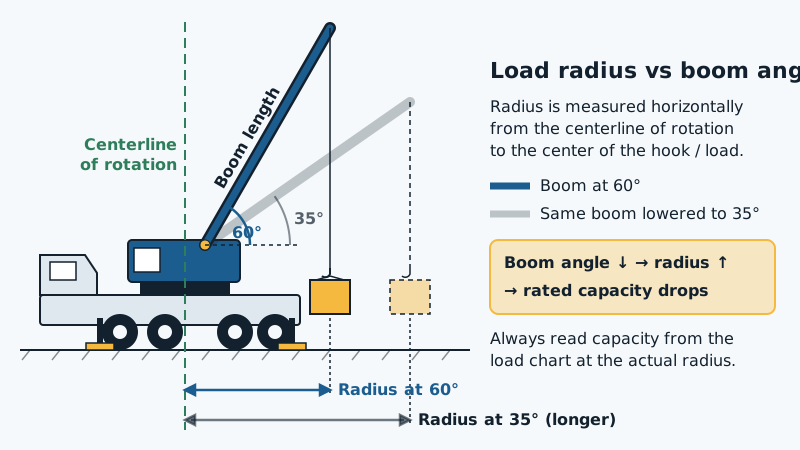
- Load chart reading: radius, boom length, deductions, parts of line and chart notes
- Outrigger setup, mat and cribbing sizing, and soil bearing on fill or saturated ground
- Power line approach distances and the steps when a lift must work near energized lines
- Rated capacity limiters, anti-two-block devices and what an operator does when one faults
- Wind, gusts and fog-reduced visibility: when to shut a lift down
- Hand and voice signals, and working with a qualified signal person
- Pre-shift inspection items and the annual crane certification by a licensed certifier
- Federal Subpart CC and ASME B30.5 concepts that appear on the written exams
What Cal/OSHA looks for when it checks the operator
Two Title 8 sections carry the rule. §5006.1 covers mobile and tower cranes in general industry, and §5006.2 covers cranes on construction work. Both point to the same basic package: a medical exam by a physician or licensed health professional, a substance abuse test, a written test and a practical test on the crane type in question. The result is a certificate from an accredited certifying entity, valid for no more than five years.
The phrase that trips people up is crane type. Holding a card for a fixed-cab boom truck does not let you run a 90-ton all-terrain, and a telescopic specialty does not cover a lattice crawler. Read your card as a list of machines you may operate, nothing broader. Some small machines sit outside the certificate rule entirely, such as general industry mobile cranes with booms shorter than 25 feet or capacities below 15,000 pounds, but the employer still has to make sure whoever runs them is trained and qualified. Our California requirements guide walks through the exemptions.
Matching a specialty to the machine on the trailer
Every candidate sits the Core exam. It is about the knowledge shared by all mobile cranes: reading the site, setting up, operating and staying within the rules. After that you pick specialties that fit your equipment.
LAT is for lattice boom cranes, crawler or truck mounted; it replaced the older LBC and LBT codes. TLL is for telescopic cranes with a cab that swings with the upper, which describes most all-terrain and rough-terrain hydros on California commercial jobs. TSS is for telescopic cranes run from a fixed cab, a group that includes many boom trucks. A narrower service truck crane (STC) designation sits under TSS for operators whose work never leaves those machines. NCCCO retired its separate fixed-cab boom truck (BTF) exam in September 2021, so boom truck operators now test for full TSS.
- Crawler on a refinery turnaround or wind repower: LAT
- All-terrain setting HVAC on a downtown roof: TLL
- Boom truck delivering trusses to a fire rebuild lot: TSS
- Mechanic's truck crane in a utility or fleet yard: STC (see that course)
California jobs that test what the exam teaches
Ground conditions are the first lesson on the Core exam, and California hands you plenty of examples. Port fill around the Los Angeles and Long Beach harbors, where Long Beach is expanding its Pier B on-dock rail yard, can be soft and wet. Burned hillside lots in Altadena and the Pacific Palisades, where rebuilding permits have been issued by the thousands since 2025, often mean setting up on slopes, retaining walls or freshly compacted pads. Central Valley high-speed rail work has put hydros and crawlers beside viaducts and grade separations across Madera, Fresno, Kings and Tulare counties.
Weather is the second. Afternoon wind through the Golden Gate, marine fog that hides a load from the cab, Santa Ana gusts in Southern California and triple-digit heat in the valley all affect what you can safely lift. The exams expect you to know that chart capacities assume calm conditions and level, firm support, and that the operator has authority to stop a lift.
The crane's own paperwork
California adds a layer most states do not have. Cranes over three tons rated capacity used for lifting must be examined, tested and certified every year by a certifier licensed through the Cal/OSHA Crane Unit, under §5021, with proof load testing at set intervals under §5022. As an operator you will see that certification on the machine and should know what to do if it has lapsed: the crane should not be working. We cover how annual certification relates to your own frequent and periodic inspections.
From first login to practical day
Start with the Core material, then move to the specialty that matches your crane and work the load chart problems until reading notes and deductions becomes routine. Practice questions in exam style are spread through each module. When you are ready, schedule the written exams through NCCCO by Online Proctored Testing, at a test center or at a test event. The practical exam is always hands-on, on the crane type you are certifying, at a practical test site arranged through the certifier. After you pass, your employer still evaluates you on the specific crane you will run.
Questions people ask
Will an out-of-state NCCCO card work in California?
NCCCO certification is national, so a current card covering the right crane type is generally what Title 8 asks for. Confirm the card lists the type you will operate and that it has not expired, and expect your California employer to run its own evaluation.
Can I run a crane while I am still studying?
Under federal rules, an operator in training may run equipment under specific supervision conditions set out in Subpart CC. Check with your employer and the current Title 8 text before assuming the same arrangement applies to your job.
Does this course schedule my practical exam?
No. The course is written exam preparation. Practical exams are arranged through NCCCO at an accredited practical site. Our enrollment advisor can answer questions about how the prep fits your timeline.
Is a physical exam really required?
Yes. California's certificate rule calls for a physical examination meeting ASME B30.5 criteria or the DOT physical standard, plus a substance abuse test, alongside the written and practical exams.
Where these facts come from (11)
- dir.ca.gov/title8/5006_1.html
- dir.ca.gov/title8/5006_2.html
- dir.ca.gov/title8/5021.html
- dir.ca.gov/dosh/cranes.html
- nccco.org/codes
- nccco.org/mobile-crane-operator
- equipmentworld.com/nccco-launches-boom-truck-operator-certification-program
- railwayage.com/intermodal/2024-a-pivotal-year-for-polbs-pier-b-rail-facility
- hsr.ca.gov/wp-content/uploads/2025/10/2025_10_02_Factsheet_Construction_Progress_v2_A11Y.p
- therealdeal.com/magazine/january-2026/after-the-la-fires
- osha.gov/laws-regs/regulations/standardnumber/1926/1926.1427
Prep courses
-
Tower Crane
Written exam preparation for the NCCCO tower crane certification, set against the extra layer of permits, notifications and certifier visits that Cal/OSHA applies to every tower crane in the state.
-
Articulating Crane
Study for the NCCCO articulating boom crane written exams online, with the California size limits that decide whether a material delivery truck needs a certified operator at all.
-
Rigger I
Learn to inspect gear, choose and tie the basic hitches and knots, and recognize rigging hazards, the core of the NCCCO Rigger Level I credential that many California employers use to document a qualified rigger.
Line up your California crane exam prep
Share the card you need, the crane you run and the part of California you work in. An enrollment advisor writes back with a course match and a plan for booking your written and hands-on exams.
- Lessons and practice questions open around the clock
- Built for the NCCCO written tests Title 8 relies on
- Advice on scheduling the practical exam near you
Ask about enrollment
A short form. Your details are used only to reply to you.