NCCCO ABC · ABL · ABW written prep
Knuckle-Boom Crane Certification Prep for California Delivery and Install Crews
Knuckle-boom trucks are everywhere in California construction: roofing material lifted onto a Sacramento subdivision, drywall boarded through an upper-floor window in Oakland, a rooftop unit set on a strip mall in Riverside. Many delivery drivers assume their truck is exempt from crane certification. In California that holds only up to a point, because the state draws the line by boom length and capacity where the federal rule does not. This course prepares you for the NCCCO articulating crane written exams online and explains where California's line falls.
Reviewed · Our research standards
Topics in the prep
- Knuckle-boom geometry: inner and outer boom, extensions and jib attachments
- Load charts that change with boom fold angle and extension stage
- Stabilizer deployment on residential streets, sidewalks and sloped lots
- Remote control operation and the operator's view of the load
- Hook versus grapple, fork and clamp attachments, and how each affects capacity
- Winch use on ABW cranes and two-blocking prevention
- Overhead power line distances on narrow urban and rural roads
- California's delivery exemption limits and the employer's training duty
California's narrower delivery exemption
Federal Subpart CC excludes many articulating cranes that only deliver material to a construction site, without a size limit. California does not go that far. Under §5006.2, an articulating or knuckle-boom crane delivering material to a site is exempt from the operator certificate only when its boom is shorter than 25 feet or its rated capacity is under 15,000 pounds. Larger delivery cranes need an operator certified for that crane type, the same as any other crane covered by the rule.
Exempt or not, the employer still has to train the operator and make sure they are qualified for the equipment. Once a knuckle-boom moves beyond delivery and starts holding components for installation, such as setting trusses or steel, the delivery exemption no longer fits the work. Our California requirements guide explains these boundaries in more detail.
Picking ABC, ABL or ABW
NCCCO divides articulating crane certification by attachment and use. ABC covers articulating boom cranes working with a hook. ABL covers articulating boom loaders, the trucks that lift and place pallets, block or bundles using a fork, clamp or grapple. ABW covers articulating boom cranes equipped with a winch. Exams can be combined, and the designations apply whether the crane is on a truck or a crawler chassis.
Each designation needs a written exam and a practical exam, and NCCCO gives you 12 months after passing the first to pass the other. Written exams are available through Online Proctored Testing, at test centers or at test events. The practical is always taken in person on an articulating crane.
What makes articulating charts harder than they look
A straight telescopic boom has one main variable, radius. A knuckle-boom has several. Capacity depends on how far the outer boom is folded, which extension stage is out and whether a jib or attachment is fitted, and some charts are split by stabilizer setup. Expect the exam to test you on reading the correct chart for the setup, not just finding a number.
The course works through these problems with exam-style practice questions, then covers remote control operation, where the operator has to watch both the load and the boom from a position on the ground.
Attachments deserve their own attention. A grapple, fork or clamp has weight of its own that comes off the chart before the load is counted, and some attachments reduce the rated capacity at certain boom positions. Operators who switch between a hook and a grapple during the same day need to account for that difference every time.
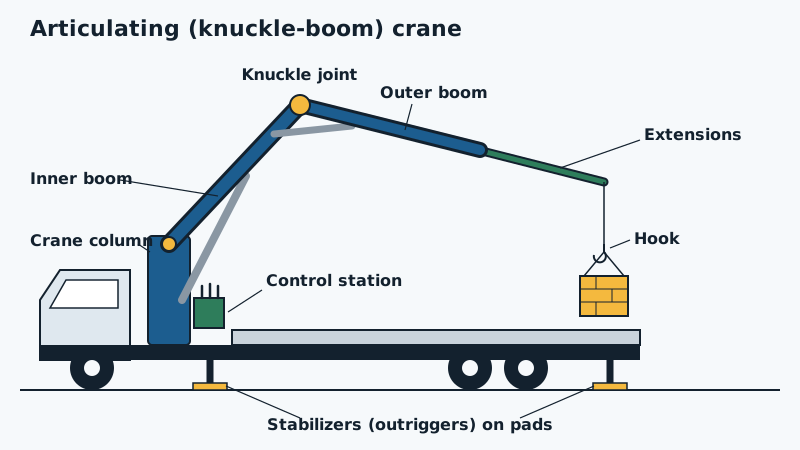
California delivery sites and their hazards
Rebuilding after the 2025 Eaton and Palisades fires has kept supply trucks moving on narrow, steep residential streets in Altadena and the Pacific Palisades, where stabilizers may land on fresh pavement, curbs or slopes. Older Bay Area neighbourhoods add overhead lines, street trees and parked cars on both sides. Central Valley and Inland Empire subdivisions bring heat and loose graded pads. Each situation tests stabilizer placement, overhead clearance and the decision to reposition instead of reaching.
- Check what the stabilizer pad is resting on before every set
- Survey for overhead lines before raising the boom
- Keep pedestrians and residents out of the swing and load path
- Reposition the truck instead of reaching beyond the chart
Questions people ask
My crane has a 22-foot boom but is rated over 15,000 pounds. Am I exempt?
The delivery exemption is worded as boom under 25 feet or capacity under 15,000 pounds, so a short boom alone may qualify. Size thresholds are easy to misread, so check the current §5006.2 text and the manufacturer's rating with your employer before relying on it.
Does annual crane certification apply to my knuckle-boom?
If the crane is rated over three tons and used for lifting, Title 8 §5021 generally requires annual examination and certification by a Cal/OSHA-licensed certifier. Ask your fleet manager where that record is kept.
I use a grapple for block and a hook for trusses. Which exams do I need?
Usually ABL for the grapple work and ABC for the hook work. NCCCO lets you combine exams, so you can prepare for both in this course.
Does this course replace my employer's training on the truck I drive?
No. The course prepares you for NCCCO's written exams and explains the rules. Your employer must still train and evaluate you on the specific crane, controls and attachments you will use, and the practical exam is always taken in person.
Where these facts come from (7)
- nccco.org/nccco/certifications/articulating-crane-operator
- nccco.org/codes
- dir.ca.gov/title8/5006_2.html
- dir.ca.gov/title8/5021.html
- cranehotline.com/articles/articulating_cranes_under_stricter_rules_in_california
- cbsnews.com/losangeles/news/first-rebuilding-permits-issued-for-eaton-and-palisades-fire-b
- osha.gov/laws-regs/regulations/standardnumber/1926/1926.1400
Prep courses
-
Mobile Crane
Online study for the NCCCO mobile crane Core written exam and the LAT, TLL or TSS specialty that matches your machine, framed around how Cal/OSHA actually checks operators on California jobs.
-
Tower Crane
Written exam preparation for the NCCCO tower crane certification, set against the extra layer of permits, notifications and certifier visits that Cal/OSHA applies to every tower crane in the state.
-
Rigger I
Learn to inspect gear, choose and tie the basic hitches and knots, and recognize rigging hazards, the core of the NCCCO Rigger Level I credential that many California employers use to document a qualified rigger.
Line up your California crane exam prep
Share the card you need, the crane you run and the part of California you work in. An enrollment advisor writes back with a course match and a plan for booking your written and hands-on exams.
- Lessons and practice questions open around the clock
- Built for the NCCCO written tests Title 8 relies on
- Advice on scheduling the practical exam near you
Ask about enrollment
A short form. Your details are used only to reply to you.