NCCCO Rigger Level II · Weights, CG and rigging plans
Rigger Level II for California's Heavier, Odd-Shaped Picks
A Level I rigger works from numbers someone else supplied. A Level II rigger is the person who supplies them. When the load is a tower-base reinforcing plate going into a bridge, an exchanger bundle coming out of a refinery unit, or a curved precast segment on a rail viaduct, somebody has to work out what it weighs, where its center of gravity sits and which slings will hold it level or let it turn. NCCCO's Rigger Level II tests exactly that, and this course walks through the math and judgment it expects.
Reviewed · Our research standards
Topics in the prep
- Estimating the weight of steel, concrete, pipe and fabricated assemblies
- Locating center of gravity on irregular and asymmetrical loads
- Sling tension at different angles and unequal leg lengths
- Spreader and lifting beams, equalizer arrangements and below-the-hook devices
- Rigging a load to stay level versus rigging it to rotate
- Load control: taglines, landing and setting on supports
- Rigging for crane assembly and disassembly under 1926.1404
- Communicating the plan to the operator, signaler and crew
From hooking up to planning the lift
NCCCO describes the Level II rigger as someone who can do everything at Level I and also handle non-routine work: determining load weight and center of gravity, selecting rigging and hardware for the configuration, and understanding load dynamics. Federal rules call for qualified riggers during crane assembly and disassembly (1926.1404) and when crews hook, unhook or guide loads in the fall zone (1926.1425). California's Group 13 orders, including §5010.1 on assembly and disassembly, carry the same expectations onto Cal/OSHA sites, since a State Plan must be at least as effective as federal OSHA.
The employer still decides who is qualified for a given lift. Level II gives that decision a third-party foundation for complex work.
California projects that need Level II thinking
Several of the state's biggest jobs are rigging-heavy rather than crane-heavy. The Golden Gate Bridge's last seismic retrofit phase, with a first construction contract awarded to Halmar International in 2025, includes heavy steel reinforcing plates at the tower bases, truss and floor beam strengthening and dozens of new energy-absorbing devices, all installed on a working bridge. In Fresno, the high-speed rail Cedar Viaduct carries the guideway over State Route 99 on a double span of arches nearly 3,700 feet long.
Port work is another source. At Oakland's TraPac terminal, Liebherr ship-to-shore cranes more than 440 feet tall arrived in sections in early 2026 and were assembled on the wharf before being commissioned. In the refinery belt along the Carquinez Strait and in the South Bay, turnaround and conversion work means removing and resetting process equipment where the center of gravity is rarely in the middle.
- Retrofit steel on bridges and buildings in seismic zones
- Precast girders and arch segments on rail and highway structures
- Crane and terminal equipment assembly at the ports
- Vessels, exchangers and rotating equipment during plant shutdowns
- High-rise structural steel and mechanical lifts in dense downtowns
The math the written exam leans on
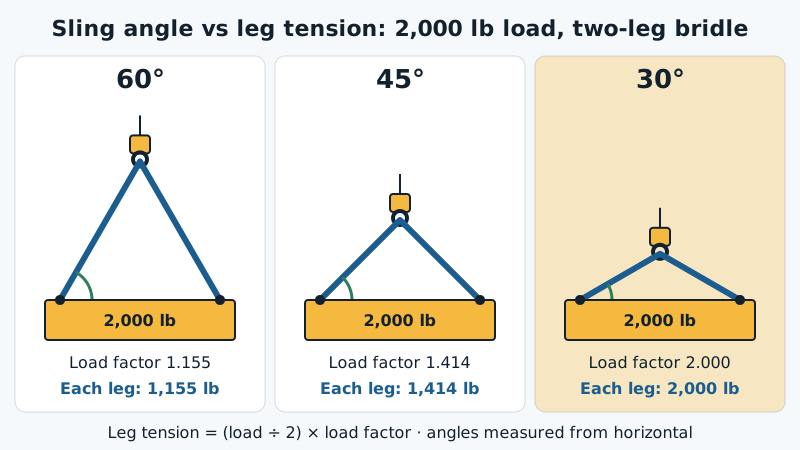
Expect to calculate. The course covers estimating weight from dimensions and material density, finding the combined center of gravity of assemblies, and working out how much tension each sling leg sees as the angle flattens or the legs differ in length. It also covers when a spreader or lifting beam changes those numbers, and how capacity charts for slings, shackles and below-the-hook devices are read.
The CCO Rigger Level II written exam is 50 multiple-choice questions with 60 minutes allowed and can be taken by Online Proctored Testing, at a test center or at a test event. Bring a disciplined method rather than memorized answers; the questions reward setting a problem up correctly.
The Level II practical and keeping the credential
The practical asks you to rig a load for a level lift and then rig a load so it rotates, which means judging the center of gravity and choosing attachment points and hardware to get the behavior you want. NCCCO encourages candidates stepping up from Level I to take the Level II written and practical together, or the practical first. Either order is allowed, with 12 months to pass the second exam after the first.
Certification lasts five years, but only while your Level I is current, so keep both renewals on the same calendar.
How the online course supports you
Lessons are self-paced and open on any device, so you can work a sling-angle problem at the kitchen table and review hardware on your phone between lifts. Worked examples build from simple two-leg picks up to multi-leg and spreader arrangements, and practice questions in exam style follow each topic.
Your hands-on skills still have to be demonstrated at the practical site. Contractors preparing a group of lead riggers can set up crew enrollment through get started.
Questions people ask
Can I go straight to Level II?
You can take the Level II exams, but the Level II certification only counts while you hold a current Level I. Many candidates test for both in the same window.
Is a calculator part of the Level II material?
Weight, center of gravity and sling tension calculations are central to Level II. Check NCCCO's current candidate handbook for the calculator rules on exam day.
Does Level II make me the lift director?
No. The credential shows rigging competence. Who directs a lift, or an assembly and disassembly, is set by Title 8 and by your employer's lift plan. The California requirements guide has the regulatory background.
Where these facts come from (11)
- nccco.org/rigger
- nccco.org/nccco/news-center/archived-press-releases/news/2010/09/25/nccco-launches-rigger-
- osha.gov/laws-regs/regulations/standardnumber/1926/1926.1404
- osha.gov/laws-regs/regulations/standardnumber/1926/1926.1425
- regulations.justia.com/states/california/title-8/division-1/chapter-4/subchapter-7/group-1
- goldengate.org/assets/1/25/2025-1218-bocomm-no3-appractsseismicengsupphdr.pdf
- equipmentworld.com/roadbuilding/article/15772538/golden-gate-bridge-seismic-retrofit-to-re
- hsr.ca.gov/wp-content/uploads/2025/10/2025_10_02_Factsheet_Construction_Progress_v2_A11Y.p
- localnewsmatters.org/2026/01/10/new-cranes-port-of-oakland
- ajot.com/insights/full/ai-trapac-commissions-liebherr-built-ship-to-shore-cranes-at-port-o
- argusmedia.com/en/news/2242603-california-refinery-conversions-face-skepticism
Prep courses
-
Mobile Crane
Online study for the NCCCO mobile crane Core written exam and the LAT, TLL or TSS specialty that matches your machine, framed around how Cal/OSHA actually checks operators on California jobs.
-
Tower Crane
Written exam preparation for the NCCCO tower crane certification, set against the extra layer of permits, notifications and certifier visits that Cal/OSHA applies to every tower crane in the state.
-
Articulating Crane
Study for the NCCCO articulating boom crane written exams online, with the California size limits that decide whether a material delivery truck needs a certified operator at all.
Line up your California crane exam prep
Share the card you need, the crane you run and the part of California you work in. An enrollment advisor writes back with a course match and a plan for booking your written and hands-on exams.
- Lessons and practice questions open around the clock
- Built for the NCCCO written tests Title 8 relies on
- Advice on scheduling the practical exam near you
Ask about enrollment
A short form. Your details are used only to reply to you.