NCCCO TSS-STC · Mechanic and fleet trucks
Service Truck Crane Certification for California Field Mechanics
A field mechanic pulling a final drive out of a dozer on a Kern County solar site, or swapping a loader tire at a Stanislaus County dairy, is running a crane even if nobody on the crew calls it that. NCCCO built a restricted credential for exactly this work: the service truck crane designation, which sits under its fixed-cab telescopic category. This course prepares you for the written exam online at your own pace and explains, in plain terms, how California's crane rules apply to a truck that spends most of its life away from a construction site.
Reviewed · Our research standards
Topics in the prep
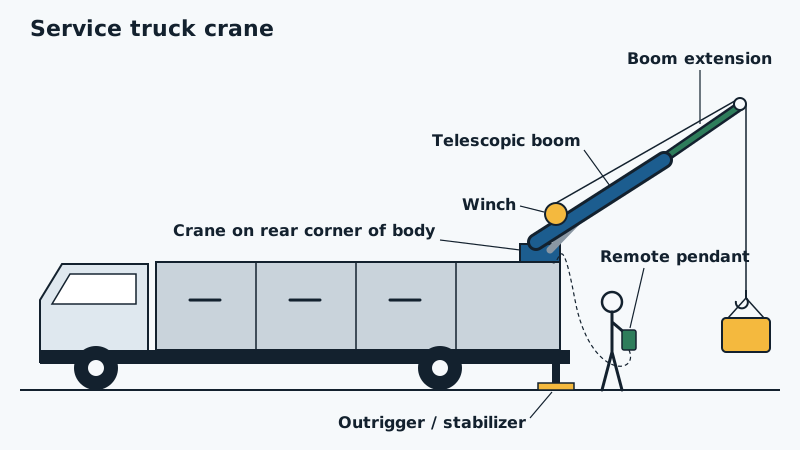
- How service truck cranes differ from boom trucks and larger telescopic cranes
- Reading compact load charts, including capacity by boom extension and angle
- Outrigger and stabilizer setup on shoulders, yards and unimproved ground
- Remote and pendant control operation, including where to stand
- Lifting components such as engines, final drives and tires safely
- Power line clearance for trucks working along utility corridors
- California's size thresholds for the operator certificate and where they stop applying
- Inspection habits and the annual crane certification for cranes over three tons
Is a certificate legally required for your truck?
California's certificate rule depends on the size of the crane and the work it is doing. Under §5006.1, the general industry rule, mobile cranes with a boom shorter than 25 feet or a rated capacity below 15,000 pounds are exempt from the certificate, which leaves many compact service cranes outside it in shop and fleet work. The employer must still train the operator and make sure they are qualified.
Construction is handled under §5006.2, and its exemption list is drawn differently, so the same truck may be treated differently once it is at a building or road project. Larger service cranes, including many rated well above 15,000 pounds for mining and heavy equipment support, need a certificate in either setting. Check the current text, or our requirements guide, before you decide your truck is exempt. Many employers require STC regardless because it shows the operator has been tested independently.
How the STC designation is set up
STC is a restricted form of NCCCO's TSS (telescopic, fixed cab) certification. You take a written exam and a practical exam, and the practical is taken on a service truck crane. The resulting card covers service truck cranes only. If you later move to boom trucks or bigger hydros, you would need full TSS.
If you already hold a fixed-cab telescopic designation, ask NCCCO whether it already covers your service truck before booking a separate test. Written exams can be taken through Online Proctored Testing, at a test center or at a test event; the practical is always done in person on a service truck crane.
Because the designation is narrow, it pays to be honest about where your career is heading. A mechanic who expects to stay on service trucks for years gets a credential that matches the work. A mechanic who sometimes borrows the shop's boom truck for deliveries would be better served by TSS from the start, since STC will not cover that machine.
Where California service cranes earn their keep
Service trucks support the machines that build and feed the state. Earthmoving fleets on Central Valley high-speed rail work, harvest and packing equipment across the San Joaquin Valley, cargo-handling equipment at the Ports of Los Angeles, Long Beach and Oakland, utility-scale solar fields in the desert, and municipal fleets in every county all depend on mechanics who can lift heavy components in the field. Mines also use service trucks, but mine sites fall under federal MSHA rules rather than Cal/OSHA's crane orders.
- Engine, transmission and final-drive removal on earthmoving equipment
- Large tire changes on loaders, haul trucks and farm tractors
- Pump and motor replacement at water, wastewater and agricultural sites
- Component swaps on port cargo-handling equipment
Habits the exam checks and the field rewards
Service cranes are often set up on road shoulders, soft field edges or uneven gravel, so stabilizer placement and leveling get real attention on the exam. So does the radius trap: a component that seems light can exceed a compact chart's capacity once the boom is extended to reach across a machine.
Remote controls let you stand close to the load, which is also where pinch points and swing hazards are. The course reviews safe operator positioning, how to plan a lift around a disabled machine, and the inspection items to check before every use. If your crane is rated over three tons, Title 8 §5021 requires annual examination and certification by a Cal/OSHA-licensed certifier, and you should know where that certification is kept on the truck.
Questions people ask
Does STC let me run a boom truck?
No. STC is restricted to service truck cranes. A boom truck with a fixed cab calls for TSS (NCCCO retired the separate BTF exam in 2021), and a swing-cab hydraulic crane calls for TLL.
My crane is under 15,000 pounds. Should I bother certifying?
It may be exempt from the certificate in general industry work, but construction jobs, customer contracts and insurers often want certified operators, and the training still counts toward the qualification your employer has to document.
Can I upgrade from STC to TSS later?
Yes. You would complete the remaining NCCCO requirements for TSS, including its practical. Our mobile crane operator course covers the Core and TSS material.
Do I need a physical and a drug test for STC?
For cranes covered by California's certificate rule, yes: Title 8 calls for a physical examination and a substance abuse test as part of qualifying for the certificate. NCCCO also has its own medical and substance abuse policies, so read the candidate handbook before you register.
Where these facts come from (8)
- nccco.org/service-truck-crane-operator
- cranebriefing.com/news/nccco-launches-service-truck-crane-certification/2085028.article
- onetonline.org/link/certinfo/11214-A
- equipmentworld.com/nccco-launches-boom-truck-operator-certification-program
- dir.ca.gov/title8/5006_1.html
- dir.ca.gov/title8/5006_2.html
- dir.ca.gov/title8/5021.html
- hsr.ca.gov/wp-content/uploads/2025/10/2025_10_02_Factsheet_Construction_Progress_v2_A11Y.p
Prep courses
-
Mobile Crane
Online study for the NCCCO mobile crane Core written exam and the LAT, TLL or TSS specialty that matches your machine, framed around how Cal/OSHA actually checks operators on California jobs.
-
Tower Crane
Written exam preparation for the NCCCO tower crane certification, set against the extra layer of permits, notifications and certifier visits that Cal/OSHA applies to every tower crane in the state.
-
Articulating Crane
Study for the NCCCO articulating boom crane written exams online, with the California size limits that decide whether a material delivery truck needs a certified operator at all.
Line up your California crane exam prep
Share the card you need, the crane you run and the part of California you work in. An enrollment advisor writes back with a course match and a plan for booking your written and hands-on exams.
- Lessons and practice questions open around the clock
- Built for the NCCCO written tests Title 8 relies on
- Advice on scheduling the practical exam near you
Ask about enrollment
A short form. Your details are used only to reply to you.